
 40% OFF
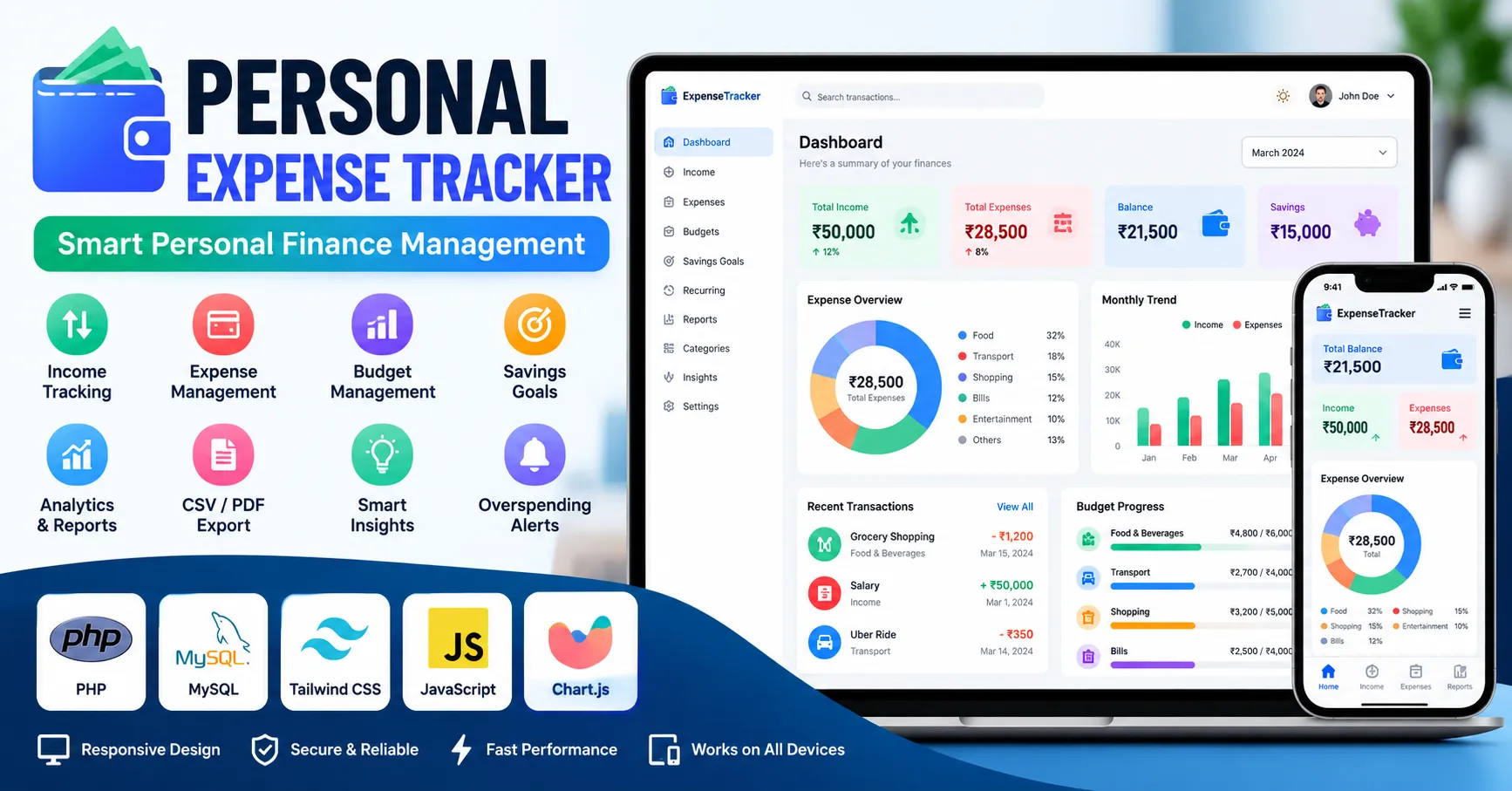
Personal Expense Tracker - Smart Web-Based Personal Finance Management System
Web ApplicationsPHPMySQLHTML5CSS3+7
₹3,000₹5,0004.1
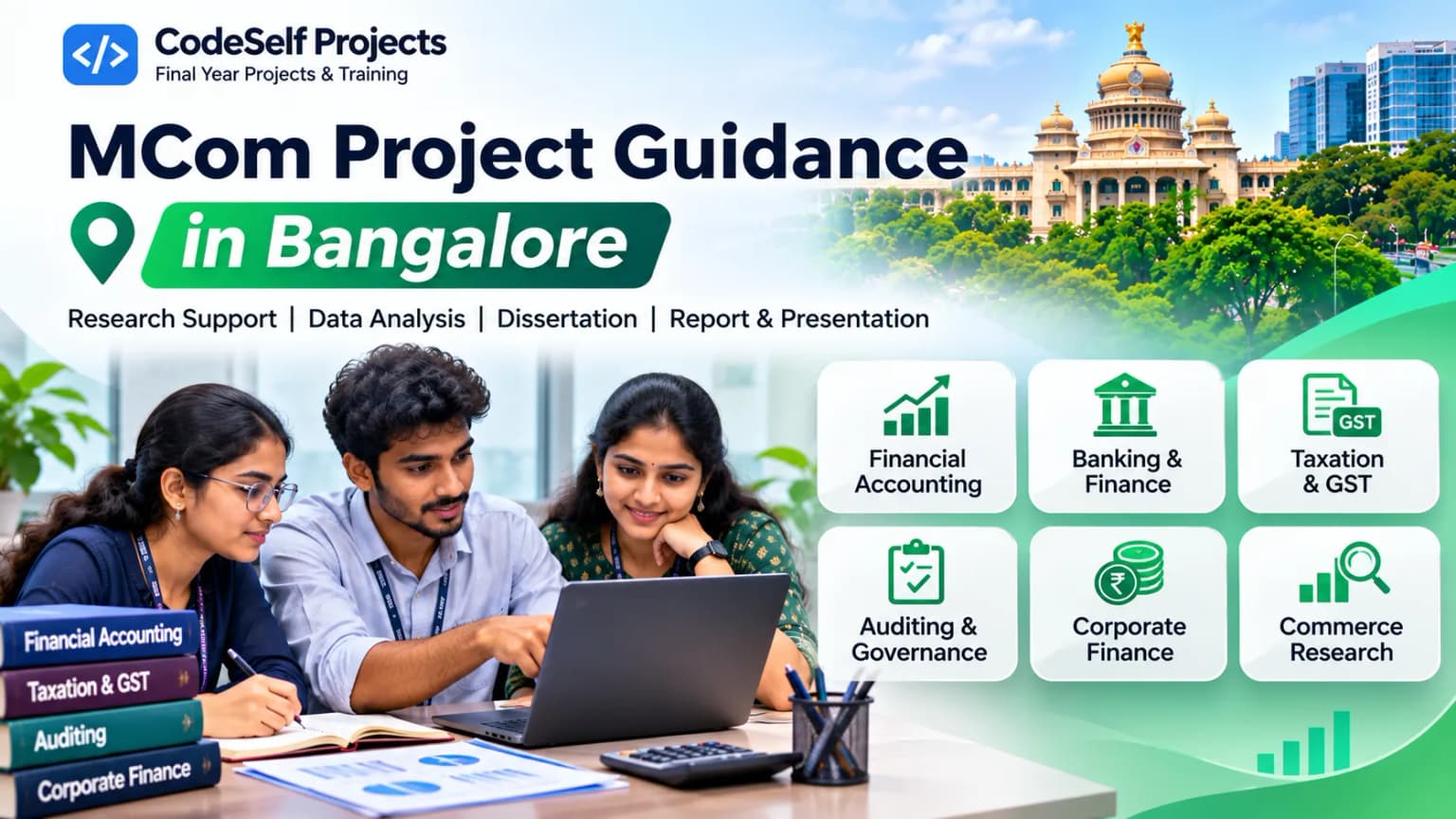
Looking for MCom project guidance in Bangalore? Get academic research support for projects involving financial accounting, taxation, auditing, banking, corporate finance and commerce analytics. Explore topic selection, research methodology, financial data analysis, questionnaire preparation, report documentation and presentation preparation based on your postgraduate course requirements and university guidelines.
Explore our Web Applications projects
40% OFF 50% OFF
 60% OFF
 20% OFF
 14% OFF
 14% OFF
 57% OFF
 29% OFF
Study financial statement analysis, accounting practices, revenue recognition, corporate reporting, working capital, cost accounting and financial performance of business organisations.
Explore banking operations, digital banking, credit management, investment decisions, financial inclusion, mutual funds, capital markets and financial services.
Research GST compliance, corporate tax planning, tax administration, indirect taxation, taxation practices and the financial implications of tax regulations for businesses.
Examine internal auditing, statutory audit processes, forensic accounting, risk management, corporate governance, financial controls and compliance practices.
Analyse capital structure, investment decisions, profitability, working capital management, dividend policies, portfolio performance and financial risk.
Work on financial datasets, business performance indicators, financial forecasting, comparative analysis, accounting information and data-supported decision-making.
Examine balance sheets, income statements and cash flow statements to understand profitability, liquidity, solvency, financial efficiency and business performance.
Calculate and interpret relevant financial ratios, including current ratio, debt-equity ratio, gross profit ratio, net profit ratio and return-based measures.
Prepare questionnaires, surveys and interview questions for research involving banking customers, investors, business owners, employees and other relevant respondent groups.
Organise information from annual reports, financial statements, RBI publications, government reports, stock exchange disclosures and relevant research publications.
Compare financial indicators across selected organisations, industries or reporting periods to identify patterns and differences relevant to the research objectives.
Organise research information and apply suitable descriptive or inferential statistical methods according to the dataset, research questions and methodology.
Examine the financial performance, working capital management, profitability, liquidity and capital structure of a selected organisation using published financial information.
Study customer preferences, digital banking services, investment awareness, mutual fund participation, banking performance and financial service adoption.
Analyse GST awareness, taxation compliance, business reporting practices and the financial impact of taxation requirements on selected business groups.
Explore internal financial controls, audit effectiveness, corporate governance practices, risk management and accountability within organisations.
Study investment preferences, risk awareness, saving patterns, financial knowledge and factors influencing individual investment decisions.
Examine business trends, financial indicators, industry performance and commerce-related information using appropriate research and analytical methods.
Share your university guidelines, proposed topic, commerce specialisation, research objectives and project submission schedule.
Review the selected topic, define the research problem and establish specific objectives that can be investigated using available information.
Determine whether the study requires primary data, secondary information or a combination of both. Identify appropriate data sources and collection methods.
Structure financial figures, company reports, questionnaire responses or other collected information and check its relevance and consistency.
Apply suitable financial calculations, comparative methods or statistical techniques and explain the results in relation to the research objectives.
Organise the research methodology, literature review, analysis, findings, recommendations, references and presentation material according to the agreed academic format.
Explore available academic project domains and research-related resources before finalising your postgraduate commerce project.
Explore project guidance for management studies, business analysis and related academic research requirements.
Explore broader academic project planning and development support for students with different project requirements.
CodeSelf connects this MCom Project Guidance in Bangalore service to matching academic departments, verified project codebases, and idea libraries.
Need personalized capstone mentoring in Computer Science Engineering? Discuss deliverables, architecture reviews, and viva preparation with specialized mentors.
Discuss Computer ProjectExplore
Project catalog
Browse
Project technologies
Review
Project details
Contact
For guidance
MCom project guidance can cover financial accounting, taxation, GST, auditing, corporate finance, banking, investment management, financial statement analysis and commerce-related research. The topic should match your postgraduate specialisation and university project requirements.
Yes. You can share your proposed topic, research problem or company-based study for a scope review. The research objectives, methodology, data requirements and expected outcomes can then be discussed.
CodeSelf Projects provides academic project guidance for MCom students in Bangalore. Requirements can be discussed for accounting, finance, taxation, banking, auditing and other commerce-related research areas.
Financial statement analysis can involve balance sheets, income statements, cash flow statements and relevant accounting ratios. The analysis should use genuine financial information from identifiable organisations and reporting periods.
Taxation-related research can examine GST compliance, corporate tax planning, business taxation practices, indirect taxation and the financial implications of tax regulations. The study should use relevant and reliable sources.
Research methodology depends on the topic and objectives. Possible methods include descriptive studies, comparative financial analysis, case studies, questionnaire-based surveys, interviews and secondary data research.
Microsoft Excel can support financial calculations, accounting ratios, charts and comparative statements. Power BI and Python may be considered for business analytics and larger datasets, while other statistical tools can be used when the research requires suitable statistical methods.
Yes. Published annual reports can provide financial statements, management information, accounting disclosures and company performance data for secondary research. The organisation, reporting period and source of the information should be documented.
Report guidance can cover the introduction, literature review, research methodology, data analysis, findings, recommendations, references and appendices. Presentation preparation can also be discussed according to the university's submission requirements.
Understand the reason for selecting the topic, the research objectives, data sources, methodology, analytical methods, findings and limitations. You should be able to explain the calculations and conclusions using the actual information collected for your study.
Academic Focus & Guidance: Looking for MCom project guidance in Bangalore? Get academic research support for projects involving financial accounting, taxation, auditing, banking, corporate finance and commerce analytics. Explore topic selection, research methodology, financial data analysis, questionnaire preparation, report documentation and presentation preparation based on your postgraduate course requirements and university guidelines. Curriculum aligned with the Computer Science Engineering Department and Web Applications & Software Systems guidelines.Curriculum updated: 25 November 2026.
Connect with our senior engineering mentors to customize modules, review base papers, and plan your capstone submission.