30% OFF
AI-Powered Smart Assistance Spectacles for Blind
IoT & Embedded SystemsPythonRaspberry Pi 4OpenCVTesseract OCR+6
₹13,999₹19,9994.6
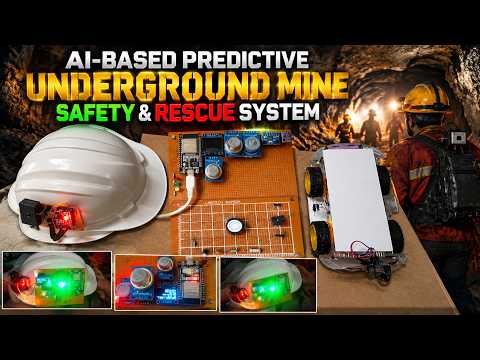
AI-Based Predictive Underground Mine Safety & Rescue System is an AI and IoT-based project designed for real-time underground mine safety monitoring, hazard detection, environmental sensing, emergency alerts, smart safety helmet integration, and rescue assistance. The system uses ESP32, gas sensors, environmental sensors, real-time monitoring, and a mobile rescue robot to support safer mining operations and emergency response.
Semester & Degree Fit
Final Year B.Tech / B.E. in Mining, ECE, CSE, IoT, or Robotics.
Hardware & Lab Prerequisites
ESP32-WROOM-32, MQ-series gas sensors (MQ-4/MQ-7), temperature/humidity sensor, 0.96-inch OLED, buzzer, LEDs, 4-wheel mobile robot chassis with 4x DC geared motors, smart safety helmet, rechargeable battery pack.
Execution Environment
Embedded C++ on ESP32 development board with Python Scikit-learn predictive analytics and mobile robotic chassis.
Student Knowledge Prerequisites
This system delivers an integrated hazard prediction and rescue assistance platform for subterranean mining operations. The architecture integrates three unified subsystems: 1. Environmental Telemetry Station: An ESP32 microcontroller interfaces MQ-series electrochemical gas sensors (monitoring methane $CH_4$ and carbon monoxide $CO$) and temperature/humidity sensors to continuously sample mine atmospheric conditions. 2. Predictive Hazard Classification: A Scikit-learn machine learning model analyzes multi-sensor patterns to predict impending toxic gas spikes and hypoxia conditions before critical thresholds are breached. 3. Smart Safety Helmet & Mobile Rescue Robot: Alerts trigger local OLED displays and helmet warning indicators; in emergency situations, a 4-wheel mobile rescue robot equipped with DC geared motors navigates compromised mine shafts remotely to assess conditions.
MQ-series and DHT sensors continuously sample methane, CO, and temperature levels.
Scikit-learn model evaluates sensor trend vectors to predict hazardous accumulation patterns.
OLED displays and smart safety helmet LEDs/buzzers sound immediate evacuation alerts.
4-wheel robotic chassis navigates contaminated shafts remotely to conduct video inspection.
Complete collects real-time gas and environmental sensor data from the underground mining environment. module with full implementation
Complete analyzes sensor readings to identify abnormal patterns and predict potentially hazardous conditions. module with full implementation
Complete monitors hazardous gas levels and generates warnings when configured safety limits are exceeded. module with full implementation
Complete tracks environmental parameters such as temperature and other configured mine safety conditions. module with full implementation
Complete integrates safety sensors and warning indicators to provide workers with immediate safety information. module with full implementation
Complete generates visual and audible alerts when dangerous or abnormal conditions are detected. module with full implementation
Complete displays sensor readings, safety status, and detected warnings for continuous system observation. module with full implementation
Complete provides a mobile robotic platform for remote inspection and assistance in potentially hazardous underground areas. module with full implementation
Q1How does the machine learning model provide 'predictive' safety rather than simple threshold alarming?
Simple threshold alarms only sound after gas concentrations have already reached dangerous levels. The machine learning model analyzes the rate of change ($dC/dt$), humidity, and temperature correlation across sliding time windows to forecast concentration spikes minutes before they breach critical explosive or toxic limits.
Q2Why is an ESP32 used as the primary embedded controller in this project?
The ESP32 features dual 32-bit Xtensa CPU cores, multiple ADC channels for parallel analog gas sensor sampling, hardware PWM for motor driver control, and integrated Wi-Fi/Bluetooth for wireless telemetry dispatch.
Q3What is the function of the 4-wheel mobile robot in emergency rescue scenarios?
When gas thresholds trigger an evacuation alarm, human entry into compromised shafts is hazardous. The mobile rescue robot can be driven into the shaft remotely to inspect tunnel integrity, verify worker locations, and transmit telemetry without endangering rescue personnel.
ESP32 Development Board
ESP32-WROOM-32
Gas Sensors
MQ-Series Gas Sensors
Environmental Sensor
Temperature & Humidity Sensor
OLED Display
0.96-inch I2C OLED
Buzzer
5V Active Buzzer
LED Indicators
Red, Green & Yellow LEDs
Rescue Robot Chassis
4-Wheel Mobile Robot Platform
DC Gear Motors
4 × DC Geared Motors
Battery
7.4V / 12V Rechargeable Battery
Smart Safety Helmet
Helmet with Integrated Sensors
Operating System
Windows / Linux
Programming Language
Python 3.10.0
Embedded Programming
C / C++
Development IDE
Arduino IDE
Machine Learning
Scikit-learn
Numerical Computing
NumPy
Data Processing
Pandas
Code Editor
Visual Studio Code
It is an AI and IoT-based safety system designed to monitor underground mining conditions, detect potential hazards, provide real-time safety alerts, and support emergency rescue operations using smart sensing and a mobile rescue robot.
The system uses connected gas and environmental sensors to continuously collect underground safety data. The sensor readings are processed by the ESP32 controller and can be analyzed using AI-based prediction techniques to identify abnormal or potentially dangerous conditions.
The smart safety helmet provides an additional layer of protection for mine workers by integrating safety sensors and warning indicators. It can help communicate hazardous environmental conditions through visual or audible alerts.
The rescue robot is designed to assist with remote inspection of potentially hazardous areas. It can carry sensors and other components to collect information from areas where sending a worker immediately may present additional safety risks.
Yes. The system can be extended with machine learning models, cloud-based monitoring, real-time dashboards, additional gas sensors, cameras, data logging, wireless communication, predictive analytics, and advanced autonomous rescue capabilities.
This capstone project belongs to CodeSelf's Mechanical & Robotics Engineering academic repository. Explore specialized engineering services, department syllabi, and related project topics.
Need personalized capstone mentoring in Mechanical & Robotics Engineering? Discuss deliverables, architecture reviews, and viva preparation with specialized mentors.
Discuss Mechanical ProjectSmart picks based on technology, category & trends