
Explore the best cybersecurity project ideas for students across Network Security, Ethical Hacking, Web Application Security, Malware Detection, Intrusion Detection, Cryptography, Digital Forensics, Cloud Security, Artificial Intelligence, and Machine Learning. Discover practical cybersecurity project topics for beginners, intermediate learners, and final year students that help you understand real-world security challenges, develop defensive security solutions, analyze threats, and gain hands-on experience with modern cybersecurity technologies.
Bottom line: Best Cybersecurity Project Ideas for Students from CodeSelf Projects is built for B.Tech, BE, MCA, BCA, and diploma students — with complete source code, documentation, demo, and viva support. Last updated: 24 September 2026.
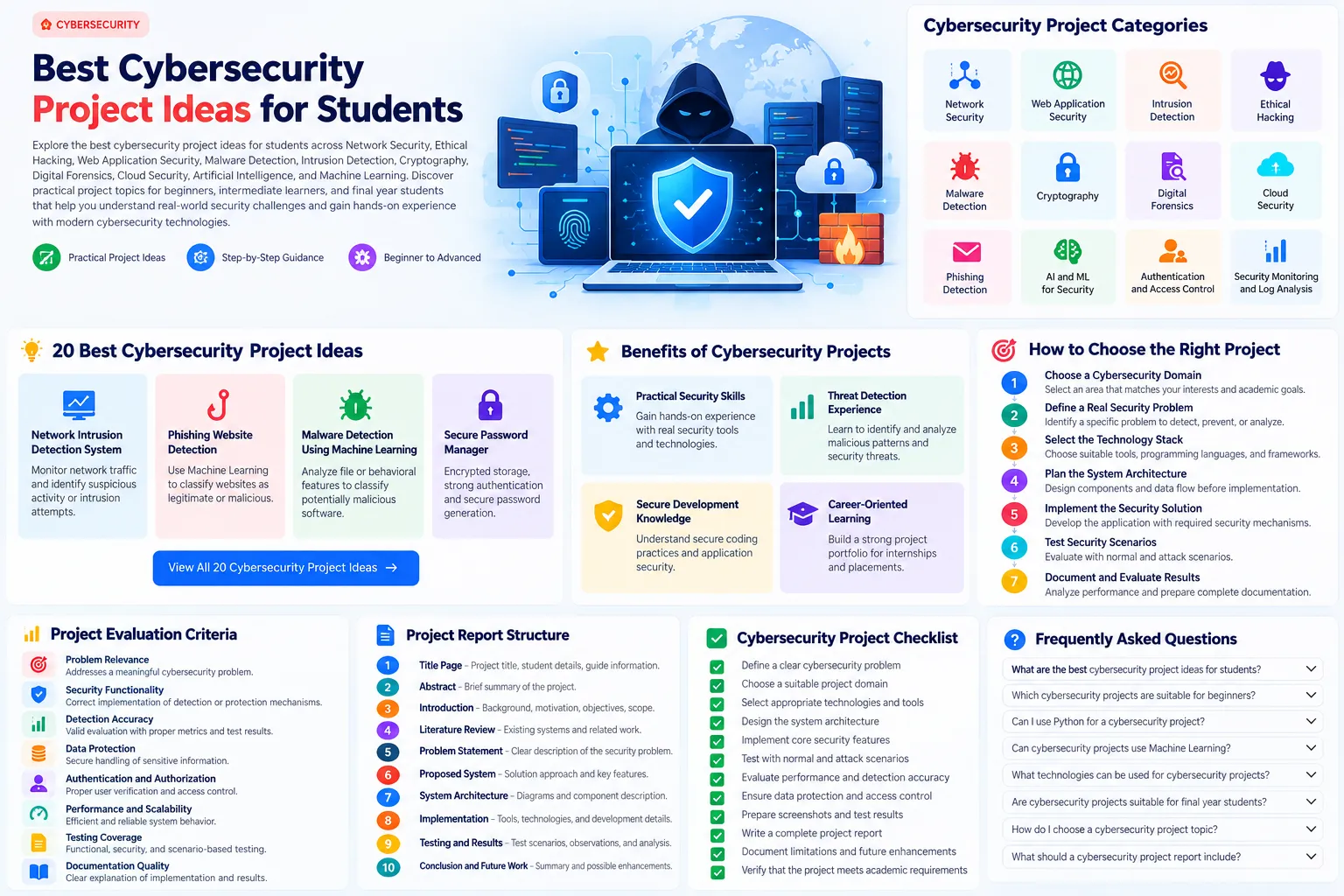
Build projects for network monitoring, packet analysis, traffic inspection, suspicious activity detection, and network protection.
Develop projects that identify common web security weaknesses such as insecure authentication, malicious requests, input validation issues, and unauthorized access.
Create systems that monitor network or application activity and detect suspicious patterns, abnormal behavior, and potential security incidents.
Develop controlled security-testing projects focused on vulnerability assessment, security auditing, penetration-testing concepts, and defensive analysis.
Build applications that analyze files, processes, or behavioral patterns to identify potentially malicious software using rule-based or Machine Learning techniques.
Explore encryption, decryption, hashing, digital signatures, secure communication, and key-management concepts through practical applications.
Develop projects for analyzing digital evidence, file activity, logs, metadata, and other artifacts used during cybersecurity investigations.
Create solutions for monitoring cloud resources, protecting sensitive data, detecting unauthorized access, and improving cloud application security.
Build systems that analyze websites, URLs, emails, or messages to identify suspicious characteristics associated with phishing attacks.
Use Artificial Intelligence and Machine Learning to detect anomalies, classify threats, identify suspicious behavior, and automate security analysis.
Develop secure login, multi-factor authentication, role-based access control, biometric authentication, and identity-management projects.
Build dashboards and monitoring tools that collect, analyze, and visualize security logs to identify unusual events and potential threats.
Develop a system that monitors network traffic and identifies suspicious activity or potential intrusion attempts using predefined rules or Machine Learning.
Build a Machine Learning-based application that analyzes URLs and website characteristics to classify websites as legitimate or potentially malicious.
Create a model that analyzes file or behavioral features to classify potentially malicious software and generate security alerts.
Develop a password management application with encrypted storage, strong authentication, secure password generation, and protected access.
Build a controlled security-analysis tool that checks web applications for common configuration and input-validation weaknesses.
Create a security tool that monitors important files and detects unauthorized modifications, deletions, or unexpected changes.
Use Machine Learning to analyze security data and identify abnormal patterns that may indicate cyber threats or suspicious activity.
Develop a voting application with authentication, access control, protected data storage, audit logging, and mechanisms designed to preserve vote integrity.
Build a dashboard that captures and analyzes network traffic statistics to identify unusual communication patterns and security events.
Create a defensive monitoring system that looks for suspicious file-operation patterns and generates alerts when ransomware-like behavior is detected.
Develop an application that analyzes email content and metadata to classify messages as normal, spam, or potentially phishing-related.
Build a tool for organizing and analyzing digital artifacts such as file metadata, activity logs, timestamps, and other investigation data.
Develop a secure authentication system combining passwords with OTP, authentication codes, or other verification mechanisms.
Create an application that manages permissions according to user roles and prevents unauthorized access to protected resources.
Build a centralized dashboard that collects security logs, filters events, visualizes activity, and helps users identify unusual behavior.
Develop a monitoring system that detects repeated authentication failures and generates alerts when login behavior indicates a possible brute-force attempt.
Create a file-sharing platform with authenticated access, encrypted transfers, permission controls, and activity tracking.
Build a defensive application that analyzes suspicious database requests and demonstrates how secure input handling can reduce SQL injection risks.
Develop a monitoring dashboard that tracks cloud-resource activity, access events, configuration changes, and potential security anomalies.
Create a platform for recording security incidents, assigning severity, tracking investigation status, maintaining evidence, and managing response activities.
Gain hands-on experience with authentication, encryption, network monitoring, vulnerability analysis, threat detection, and security testing.
Understand how network traffic, protocols, devices, and communication patterns can be monitored and protected against suspicious activity.
Learn how security systems identify abnormal behavior, malicious patterns, phishing attempts, malware, and other potential threats.
Explore how Machine Learning can be applied to anomaly detection, malware classification, phishing detection, and automated cyber threat analysis.
Understand secure coding practices, input validation, access control, authentication, data protection, and application security principles.
Develop experience analyzing logs, file metadata, timestamps, system artifacts, and other digital evidence used in security investigations.
Work with realistic security scenarios that require analyzing problems, identifying risks, designing defensive solutions, and evaluating results.
Gain practical exposure to programming languages, databases, Linux environments, networking tools, security frameworks, and monitoring technologies.
Build demonstrable cybersecurity applications that can be included in academic portfolios, resumes, GitHub repositories, internships, and placement preparation.
Develop foundational experience relevant to areas such as cybersecurity analysis, network security, application security, cloud security, digital forensics, and security engineering.
Select an area that matches your interests and academic requirements, such as network security, web security, malware detection, digital forensics, cryptography, cloud security, or threat detection.
Identify a specific cybersecurity problem and clearly describe what needs to be detected, prevented, monitored, analyzed, or protected.
Choose suitable technologies such as Python, Java, JavaScript, Linux, databases, networking libraries, Machine Learning frameworks, or security tools based on the project scope.
Design the major components, data flow, authentication mechanisms, processing logic, storage, monitoring modules, and security controls before implementation.
Develop the core application and integrate the required detection, prevention, monitoring, encryption, authentication, or analysis mechanisms.
Test the project with normal and suspicious inputs, different user roles, expected attack scenarios, and edge cases to evaluate whether the security mechanisms work correctly.
Measure the project results, record important findings, prepare screenshots and test results, explain limitations, and document possible future improvements.
The project should address a clearly defined cybersecurity problem with a meaningful security objective and practical use case.
The system should correctly perform its intended security function such as detection, monitoring, authentication, analysis, prevention, or protection.
Projects involving threat or anomaly detection should be evaluated using suitable metrics and clearly documented test results.
Sensitive information should be handled securely using appropriate access controls, encryption, hashing, validation, and protected storage mechanisms.
The project should properly verify users and restrict access to resources according to defined permissions and roles.
Evaluate response time, processing speed, resource usage, scalability, and system behavior under different workloads.
Include functional, security, negative, boundary, and scenario-based testing to demonstrate that the system behaves correctly under different conditions.
The interface should make security information, alerts, reports, dashboards, and system actions understandable and easy to use.
The application should handle expected failures, invalid inputs, unexpected events, and repeated operations without compromising security or stability.
Document the problem, objectives, architecture, methodology, implementation, testing, results, limitations, and future enhancements clearly.
25,000+
Projects
10,000+
Happy Students
100+
Technologies
24/7
Expert Support
Popular cybersecurity project areas include network intrusion detection, phishing detection, malware detection, secure authentication, web application security, file integrity monitoring, digital forensics, cloud security, security log analysis, and AI-based threat detection.
Beginners can start with projects such as a secure password manager, file integrity monitoring system, basic phishing detection, security log analyzer, role-based access control system, or multi-factor authentication application.
Yes. Python is commonly suitable for cybersecurity projects involving network analysis, automation, log processing, threat detection, Machine Learning, file analysis, APIs, and security dashboards.
Yes. Machine Learning can be used for applications such as phishing detection, malware classification, anomaly detection, intrusion detection, spam analysis, and cyber threat classification.
Depending on the project, students can work with Python, Java, JavaScript, Linux, SQL databases, networking libraries, Machine Learning frameworks, web frameworks, APIs, and security-analysis tools.
Yes. Cybersecurity projects can be developed as final year projects when they have a clearly defined problem, suitable technical architecture, implementation, testing, measurable results, and complete documentation.
Choose a project based on your cybersecurity interest, programming knowledge, available dataset or test environment, project duration, academic requirements, and the security problem you want to solve.
A project report should normally explain the problem statement, objectives, existing system, proposed solution, system architecture, methodology, technologies, implementation, testing, results, limitations, conclusion, references, and future enhancements.
Our team of experts can help you select the perfect project based on your skills, interests, and academic requirements.